Heads up: some links on this page are affiliate links. If you buy through one we may earn a commission at no extra cost to you. It never changes a ranking, and we accept no payment for placement. The full version.
For launching, a dense wood-fiber composite is the best of the three - it takes a thinner edge than bamboo, it does not absorb water, and it is the only one that goes in a dishwasher. Hardwood is the best surface to build and serve on. Bamboo is the cheapest and the lightest, and it is the one that wears out first.
Three materials, sold under one word
"Wooden peel" covers three genuinely different things, and the differences change how the tool behaves.
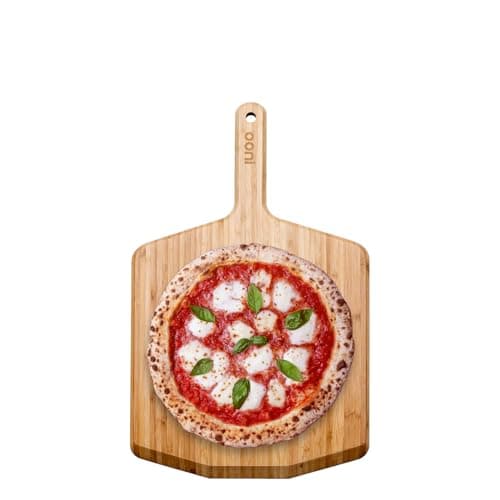
Bamboo is not a wood at all - it is a grass, cut into strips and laminated with adhesive into a board. That construction is why bamboo peels are cheap and light, and why they eventually delaminate at the edge if they are repeatedly soaked and dried.
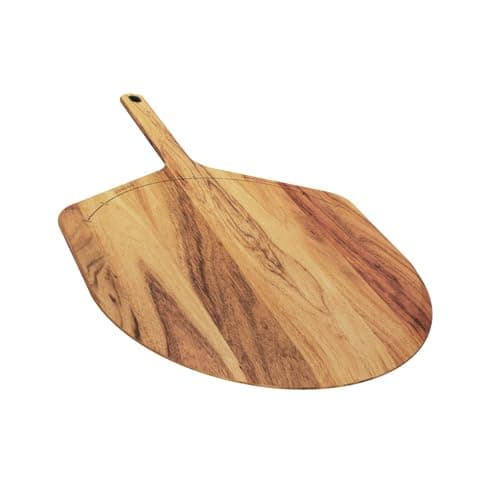
Hardwood - acacia, maple, beech - is solid timber. Heavier, thicker at the edge, and the material that takes a knife best, which is why hardwood peels are so often sold as serving boards too.
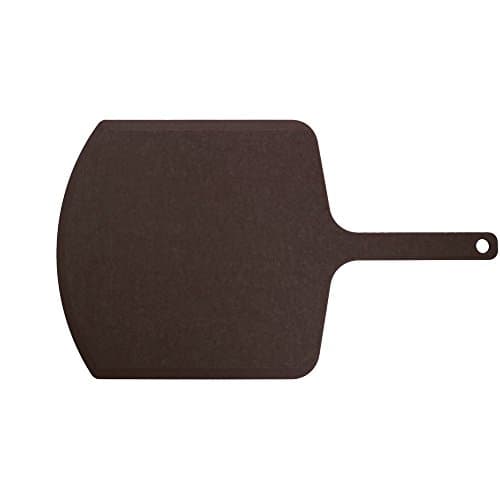
Wood-fiber composite - Richlite and similar - is paper or wood fiber compressed with resin into a dense sheet. It machines to a thin edge, ignores moisture, and is usually NSF listed and dishwasher safe. It costs the most.
What we did not do
We have not baked on any of these. Every guide in this category says it tested a dozen stones; we would rather say plainly that we did not. What we did instead is on this page in full: published specs with their sources, thermal arithmetic from material constants with the working shown, and the makers' own manuals read rather than paraphrased.
What we judged them on
Edge thickness. The single property that decides whether a peel gets under a dressed base or shoves it. Thin wins, and the materials differ by a factor of two or more.
Grain. A surface that holds a dusting of semolina releases better than a slick one. This is the reason wood launches more forgivingly than bare aluminum, and it is covered in wood versus metal.
Moisture behavior. Dough is wet and washing up is wetter. Solid timber moves with humidity, bamboo laminate can separate, composite does neither.
Weight and length. A peel is a lever. Published overall lengths here run from 24 to 25 inches, which is short next to a 27 to 32 inch metal peel - relevant if you are reaching into a hot oven mouth.
Cleaning. Whether it survives a dishwasher, and whether it needs oiling.
The three, with their published specifications
Composite (Epicurean)
Hardwood (Gozney acacia)
Bamboo (Ooni)
Material
Richlite wood fiber
Solid acacia
Laminated bamboo
Size
14" x 24"
14" head, 25" overall
12" head
Thickness
Thin machined edge
About 0.5"
Board thickness
Dishwasher
Yes
No
No
Doubles as
Cutting board
Cutting and serving board
Serving board
0.5 in
The published thickness of a hardwood placement peel, against a metal blade measured in fractions of a millimeter
That is the trade in one number. Half an inch of acacia is a superb board and a blunt instrument for sliding under a baked pizza - which is why every wooden peel here is a launching and serving tool, not a retrieval tool.
Composite: the one we would buy to launch from
Richlite-type board is what commercial kitchens reach for, and the reasons are practical rather than romantic. It machines to a genuinely thin leading edge, it does not swell or split because there is nothing in it to absorb water, and it can be washed properly rather than wiped.
The honest downsides: it is the most expensive of the three, it is heavier than bamboo, and it has no charm at all - nobody serves a pizza on a black composite board for the look of it.
Hardwood: the best board, the bluntest edge
Acacia is dense, takes a knife without scarring, and Gozney publishes something almost nobody in this category does - head size, handle length, total length, and an explicit list of which of its ovens the peel does and does not fit.
Note that 25-inch overall length against a 27.5 to 32 inch metal peel. In a domestic oven that is fine. At the mouth of a 900 F portable oven, eight and a half inches of handle is not much distance between your hand and the fire - which is the argument made in the outdoor peel roundup.
Hardwood also asks for maintenance: no dishwasher, no soaking, and an occasional wipe of food-safe oil. The routine is in how to care for a wooden peel.
Bamboo: cheapest, lightest, shortest-lived
A bamboo peel is a perfectly good way to start. It is light, which helps a nervous launch, it holds semolina well, and it costs a fraction of the other two.
What you are accepting is a laminate. Repeated wetting and drying works at the glue lines, and a bamboo peel that has been washed carelessly for two years will show it at the leading edge - the exact part of the tool that has to stay flat and thin. Treat it as a consumable and it is excellent value.
Every wooden peel fails at the same place for the same reason: the leading edge, after being soaked. Composite is the only one of the three that does not care.
What no wooden peel is good at
Retrieving. A baked pizza sits flat against a hot surface, and getting under it takes an edge measured in fractions of a millimeter. Half an inch of hardwood lifts the crust instead of sliding beneath it, and holding any wood against a 500 F stone scorches it.
That is not a failure of the material - it is why the standard setup is wood to launch and thin metal to turn and retrieve. The full comparison is in wood versus metal, and the ranked metal options are in the peel roundup.
Which to buy
Composite if you want one wooden-style peel that launches well, cleans properly and lasts indefinitely.
Hardwood if you want to build, cut and serve on the same object, and you do not mind hand washing. Check the length against your oven before buying.
Bamboo if you are starting out or buying a second board to dress pizzas on, and you accept that it will not last forever.
And size it properly whichever you choose - blade at least as wide as the pizza, no wider than the surface, per the size guide.
The picks
What we would buy
Epicurean
Epicurean Richlite Pizza Peel, 14 x 24
A pressed wood-fiber board that behaves like wood for launching and like a cutting board afterwards. The number that matters is the one nobody quotes: it is rated to 350 F, so it is a transfer tool, not an oven tool.
Wood is the surface a raw base does not stick to, which makes this the thing you build on. It is also a serving board, which is the only honest reason a peel should be pretty.
For launching, a wood-fiber composite such as Richlite - it takes the thinnest edge, does not absorb water and is dishwasher safe. Among true woods, a dense hardwood like acacia or maple lasts longest and serves best; bamboo is the cheapest and the first to wear.
Is bamboo good for a pizza peel?+
It is light, cheap and holds semolina well, which makes it a good first peel. It is a laminate, so repeated soaking eventually works at the glue lines - treat it as a consumable rather than a lifetime tool.
Can you put a wooden pizza peel in the dishwasher?+
Hardwood and bamboo, no - soaking is what destroys them. Wood-fiber composite boards are generally dishwasher safe, which is one of the main reasons commercial kitchens use them.
Why not use a wooden peel to take the pizza out?+
Because the edge is too thick to slide under a baked base, and wood held against a 500 F surface scorches. Launch with wood, retrieve with thin metal.
Does the wood affect how the pizza tastes?+
No. The dough touches the peel for a minute at most and nothing transfers. What the material changes is release, durability and how you clean it.
Sources
Every number on this page came from one of these, or from arithmetic on one of these that we showed in full.