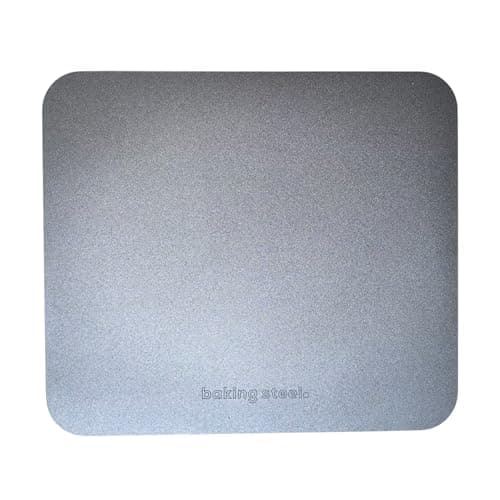
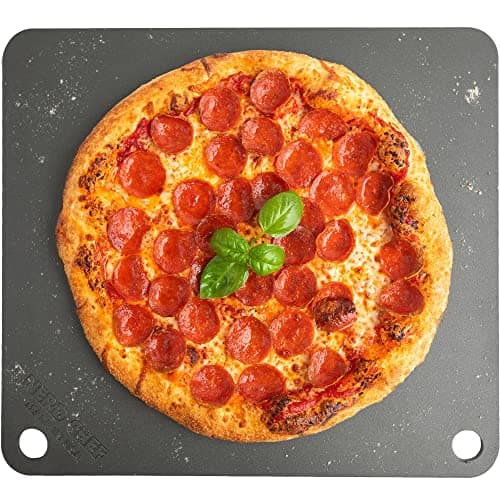
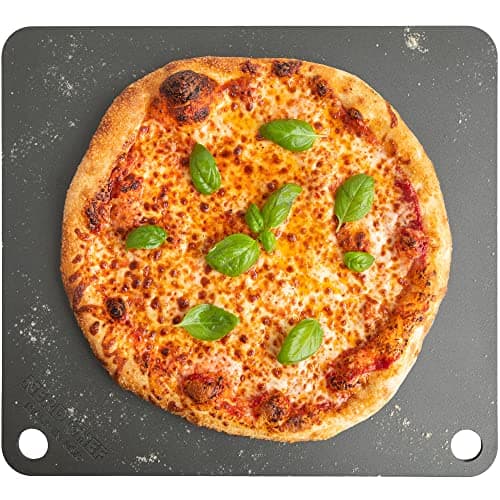
It ships seasoned, soap is allowed, and the whole ongoing job is: scrape it, wash it, dry it properly, wipe on a film of oil. About ninety seconds. The one rule that matters is the drying.
Heads up: some links on this page are affiliate links. If you buy through one we may earn a commission at no extra cost to you. It never changes a ranking, and we accept no payment for placement. The full version.
The short version
A pizza steel is bare carbon steel, so it can rust, and the thin polymerized oil film that stops it rusting is what everyone means by seasoning. Both plates we recommend arrive already seasoned, so there is nothing to do before the first bake. After that the entire job is four steps and about ninety seconds: scrape it while it is still warm, wash it, dry it completely, and wipe on the thinnest film of oil you can manage. Re-season properly once or twice a year, which is an hour of oven time you spend doing something else.
If you are asking this question before buying rather than after, the honest answer is that the maintenance is not the reason to choose a stone over a steel. The reasons to choose between them are weight, cost and what they do to a base, and those are in pizza stone vs steel.
Does a pizza steel need seasoning? Yes - and here is each maker's own answer
Both makers ship a seasoned plate and both publish a re-seasoning procedure, which settles the question more firmly than any amount of forum opinion.
Published claim
Baking Steel Original
NerdChef Steel Stone
Arrives seasoned
Yes - "arrives pre-seasoned and ready to use", both sides
Yes - the listing states it is seasoned with flaxseed oil
Seasoning oil used at the factory
Organic flax oil, baked in a commercial oven after shot-blasting to bare metal
Flaxseed oil, hand-applied
Re-seasoning oil
"a thin coat of flaxseed or vegetable oil", or "any other oil really"
Not published
Re-seasoning frequency
"typically needed only once or twice a year depending on use"
Not published
Soap
"Mild soap is okay if needed"; the care page says "Hand wash with light soap and water"
Not published
Dishwasher
"Never put it in the dishwasher"
Not published
Warranty
Lifetime against defects; warping from direct flame is excluded
"guaranteed for life", per the listing
Note the two empty cells and what they mean. NerdChef publishes a seasoning claim and a lifetime guarantee and then goes quiet on care, which is the same gap our review of that plate flagged. Baking Steel publishes more detail than any other maker in this category, and we have used their figures where NerdChef has none - but a figure borrowed from a competitor is not the same as a figure the maker stands behind, and we are not going to pretend it is.
What we did not do
We have not baked on any of these. Every guide in this category says it tested a dozen stones; we would rather say plainly that we did not. What we did instead is on this page in full: published specs with their sources, thermal arithmetic from material constants with the working shown, and the makers' own manuals read rather than paraphrased.
The contradiction inside Baking Steel's own instructions
Their two pages give two different re-seasoning temperatures. The product FAQ says to "apply a thin coat of flaxseed or vegetable oil and bake at 500 F for one hour". Their out-of-box care page says to "set oven to 375-400 degrees", place the steel on the middle rack and "bake your Baking Steel for an hour".
Both procedures work, because polymerization is a slow oxidation that happens across a wide band of temperatures - hotter means faster and more brittle, cooler means slower and more durable. The reason to flag it is not that either page is wrong. It is that if you follow one page and then read the other, you will think you did it incorrectly. You did not. If you want a rule: use the lower setting, because a flax film laid down fast at 500 F is the one most likely to flake, which is the standing criticism of flax as a seasoning oil.
375-500 F
The span between the two re-seasoning temperatures Baking Steel publishes for the same plate
Product FAQ: 500 F for an hour. Out-of-box care page: 375-400 F for an hour. We would use the lower end and expect a tougher film.
The one rule where steel and stone are exact opposites
This is the single most useful thing on this page, because almost everybody owning both gets it backwards at least once.
Cordierite stone
Carbon steel plate
Soap
Never. A porous body absorbs detergent and releases it back into food for months
Allowed. Baking Steel publishes "light soap and water" and "hot, soapy water and a stiff brush" for a re-season
Water
A damp wipe at most; never soak, never a wet stone into a hot oven
Wash it properly - then dry both sides thoroughly, which is the whole discipline
Oil
Never. Oil soaks into ceramic, goes rancid and smokes
Always, after any wash. A film so thin it looks like you missed
What failure looks like
A crack, usually from thermal shock, and it is terminal
Orange surface rust, and it is reversible in an hour
The stone side of that table is the subject of how to clean a pizza stone, which goes much further into staining, burn-off and the baking-soda question. If you own both surfaces, read both pages once and then never think about it again.
A bench scraper while the plate is still warm does most of the work. Baking Steel's own care page suggests exactly that: scrape the matter off into the sink before any water is involved.
Rust: what causes it, and the hour that undoes it
Rust on a steel is iron oxide forming where bare metal has sat in contact with moisture, and it needs three things: exposed metal, water, and time. Seasoning removes the first, drying removes the second. In practice there are exactly four ways people get there.
Washing it and leaving it to air dry. The most common one by a distance. Air drying leaves a film of water in contact with the plate for an hour, which is all it takes to put a bloom on bare patches. Baking Steel's wording is "be sure to dry both sides thoroughly" - both sides, because the underside is the one you forget and the one sitting on a rack where you will not see it until it is orange.
Storing it somewhere humid. A cupboard under a sink, a garage, a basement. The maker's answer to this is to leave the plate in the oven, which they say "protects it from rust" - and most owners do, which is why the steel is a permanent resident on a rack rather than a thing you put away.
Letting a wet dough or a tomato sauce spill sit on it overnight. Acid and salt strip seasoning faster than water alone.
Taking a scouring pad to a stain. Anything abrasive enough to remove a mark is abrasive enough to remove the film protecting the metal under it. Baking Steel points at a cleaning brick for stuck-on matter and surface rust rather than steel wool.
The fix for existing rust is the same as the re-season: scrub the orange off, wash it in hot soapy water with a stiff brush, dry it completely, wipe on a dab of oil, and give it an hour in the oven. The plate is not damaged. Carbon steel at a quarter inch has a lot of thickness to lose before surface rust is anything other than cosmetic, which is the part nobody tells you when they are warning you off a steel.
What this does not change
It is not a reason to pick a stone. Ninety seconds after a bake and an hour twice a year is a smaller commitment than remembering not to put a cold stone into a hot oven, which is the stone's equivalent discipline and has a worse failure mode.
Do not take it outdoors to avoid the issue. A grill runs far above what a kitchen oven asks of a seasoning film, and the published warranty on the Baking Steel excludes warping from direct flame. The outdoor case has its own page in the best pizza steel for a grill.
Thickness does not change the maintenance. A half-inch plate is the same surface chemistry as a quarter-inch one; it is twice the mass and twice the preheat, which is the argument in how thick should a pizza steel be.
The plate to buy, if care is what you were weighing
Best for someone who wants the maker to have published the answers: the Baking Steel Original. A published 15 lb, a quarter inch, pre-seasoned on both sides with organic flax oil, and - uniquely in this category - actual written procedures for washing, drying, oiling, re-seasoning and surface rust. Every quoted instruction on this page comes from them. That is worth something on a product you will own for thirty years.
Best cheaper plate, if you accept less documentation: the NerdChef Steel Stone Standard. Same quarter-inch thickness, a slightly larger 16 x 14.25 footprint, flax-seasoned, guaranteed for life. The care guidance is thinner, so the Baking Steel procedure above is what you will end up following.
Best for a household that bakes bread as well: the NerdChef Ultimate. A half inch, and by our arithmetic on its published dimensions about 32 lb and roughly 55 minutes to reach 95 percent of oven temperature from cold. Nothing about the seasoning changes. Everything about the handling does, and a plate that heavy is one you leave in the oven permanently whether or not rust was on your mind.
The picks
What we would buy
Baking Steel
Baking Steel Original, 16 x 14 x 1/4
A quarter inch is the thickness where a steel stops being a novelty and stays a thing you can still lift. Its advantage over a stone is not preheat speed - it is what happens one second after the base lands.
The same quarter-inch plate, from the one maker in this category that states conductivity and heat capacity as two separate numbers instead of mashing them into one slogan.
Thirty-two pounds of carbon steel. Genuinely the most thermally capable surface here, and genuinely the one most likely to sit in a cupboard because you cannot face lifting it.
It arrives seasoned, so not before the first bake. After that, yes: wipe on the thinnest possible film of oil after any wash, and do a full re-season - oil on, an hour in the oven - once or twice a year. Baking Steel publishes that frequency themselves.
What oil should I season a pizza steel with?+
Both makers use flaxseed oil at the factory. For re-seasoning at home, Baking Steel says "a thin coat of flaxseed or vegetable oil" and elsewhere "any other oil really", which is a fair reflection of how little it matters. Flax polymerizes fastest and is the one most often reported to flake; a neutral vegetable or canola oil at a lower oven temperature gives a slower, tougher film.
Can you use soap on a pizza steel?+
Yes - and this is the opposite of the rule for a stone. Baking Steel's own care page says to hand wash with light soap and water, and their re-seasoning procedure calls for hot soapy water and a stiff brush. Soap does not survive in a polymerized oil film the way it soaks into porous cordierite. Dry both sides thoroughly afterwards and re-oil.
How do you get rust off a pizza steel?+
Scrub the orange off - Baking Steel point at a cleaning brick rather than steel wool - then wash in hot soapy water, dry completely, wipe on a dab of oil and bake it for an hour. Surface rust on a quarter-inch plate is cosmetic, not structural, and the plate comes back.
Can you leave a pizza steel in the oven all the time?+
Yes, and the maker recommends it: they say many bakers leave it in permanently and that doing so protects it from rust. Take it out when you need the space for a large roast. The cost of leaving it in is that every preheat now has 15 lb of steel to warm up as well as the air, which is covered in what preheating costs.
Is a pizza steel dishwasher safe?+
No. Baking Steel's instruction is "never put it in the dishwasher". A dishwasher cycle combines detergent, prolonged water contact and a hot wet finish, which is three of the four ways a plate rusts in one go.
Why is my pizza steel turning darker?+
That is the seasoning building, not a fault. Baking Steel describe it directly: the color of the steel "will darken with each use", which they treat as normal and protective. A plate that has gone near-black is a plate that has stopped needing much from you.
Sources
Every number on this page came from one of these, or from arithmetic on one of these that we showed in full.