Heads up: some links on this page are affiliate links. If you buy through one we may earn a commission at no extra cost to you. It never changes a ranking, and we accept no payment for placement. The full version.
What this review is
We have not baked on a biscotto stone. What follows is what the kilns, the importers and the US retailers actually publish about this clay, what they conspicuously do not publish, and the one question that decides whether it belongs in your oven. The method is on the methodology page.
What we did not do
We have not baked on any of these. Every guide in this category says it tested a dozen stones; we would rather say plainly that we did not. What we did instead is on this page in full: published specs with their sources, thermal arithmetic from material constants with the working shown, and the makers' own manuals read rather than paraphrased.
What biscotto is
Biscotto is a clay slab, not a ceramic one. The US retailer that imports the Saputo stones describes them as handmade by artisans in Naples, from a clay exclusive to that region, and fired in a wood-fired kiln. The Italian kiln selling the Sorrento version is more specific about why the clay matters: the soil is "rich in clay with volcanic silicon and pumice", which gives the finished slab a notable porosity.
Porosity is the whole product. The published claim is not that biscotto gets hotter or holds more heat than cordierite - it is that the slab absorbs humidity from the dough while it bakes, so the base sets without scorching. The importer states the stones will "cook a pizza at 850 F for 60-90 seconds, without burning the bottom of the pizza", and attributes that to the mineral content of the alluvial clay plus its moisture absorption.
The temperature that makes it make sense
The number that decides this purchase is not the stone's. It is the oven's. The same retailer cites the international standard for authentic Neapolitan pizza: a stone temperature of 430 to 480 C, which is 806 to 896 F.
806-896 F
The stone temperature biscotto is made for
A kitchen oven tops out around 500-550 F. That is roughly 300 degrees below the bottom of the range where biscotto's advantage exists, which is why this is a portable-oven purchase and not a home-oven one.
At 900 F a 60-second bake is a race between a set base and a burned one, and cordierite - dense, non-absorbent, quick to dump heat into wet dough - loses that race often enough that Naples settled on a different material. At 550 F there is no race. Nothing is burning the base of a pizza that needs six or seven minutes to cook, so the problem biscotto solves does not arise. Our home oven temperature guide works through what 500-550 F can and cannot do, and the portable-oven stone guide covers the ovens that do reach the biscotto range.
The published specification
The stone below is the one biscotto listing we found actually in stock. Everything in this table is either printed on the listing or marked as absent.
Specification
Published figure
Dimensions
33.5 x 33.5 x 2 cm, which is 13.2 x 13.2 x 0.79 inches
Material
Refractory clay, described only as Casapulla biscuit, Saputo, made in Italy
Listed brand
The importing reseller, not the kiln
Maximum temperature
Not on this listing. The official Saputo retailer publishes 500 C (932 F)
Weight
Not published anywhere we looked
Thermal figures
No density, no conductivity, no specific heat, from any source
That last row is why this review carries no preheat time and no retention curve. Every other baking surface on this site gets both, computed from published dimensions and material constants with the working shown. Biscotto gets neither, because the constants do not exist in public - and borrowing cordierite's would manufacture exactly the comparison you came here to check. The same restraint applies to other unpublished clay bodies.
Sorrento, Casapulla, Saputo: read the title twice
Three names circulate as if they were one product, and they are not used consistently. The listing we rank is titled "Casapulla Biscuit for Pizza Oven Saputo" - two of the three names at once. Meanwhile the Italian kiln selling Biscotto di Sorrento draws a line between them, stating that the difference between the Sorrento biscuit and "other types of bricks on the market such as the Casapulla biscuit" is the Sorrento clay's ability to absorb humidity from the dough and so not burn the base.
Treat that as what it is: a claim by a seller of one clay about a competing clay, not a measured result. Nobody publishes a side-by-side. What it does tell you is that "biscotto" is a category, not a guarantee, and that a listing using all three words together has not told you which kiln fired the slab in the box.
Biscotto is a floor for an oven that runs at 800 F and up. In anything cooler it is an expensive way to bake the same pizza a cordierite slab would have baked.
Buying one is the actual difficulty
We checked four channels on 2026-09-26 and none of them was straightforwardly in stock:
Channel
What we found on 2026-09-26
Amazon, via an Italian reseller
One 33.5 cm square read "Only 5 left in stock", a round read "Only 1 left", and two further sizes carried no availability at all - back ordered
The official Saputo retailer
Size-matched stones for the Ooni Koda 16, Karu 16, Karu 2 Pro and a long list of other 16-inch ovens were priced in euro and marked "Arriving soon"
Fornace Aversa, the Italian kiln
Twelve footprints from 30 x 30 cm to 50 x 50, in 1.5, 2, 2.5 and 3 cm thicknesses - every variant sold out or unavailable
Fontana Forni USA
Saputo stones sold only with the purchase of one of its ovens, and those ovens are four-figure buys
That is not a temporary blip we can promise will pass, and it is worth knowing before you plan a build around this clay. It is also why the buy button below points at a listing whose stock we verified this week rather than at the kiln.
Living with a porous slab
The official retailer's instructions are stricter than anything a cordierite maker asks for, and they follow from the porosity:
Break it in. Three 20-minute phases at low, then medium, then high temperature, cooling fully between each.
Never use water. Wipe the smooth face with a barely damp cloth to remove dust before first use, then clean solid residue with a metal brush only.
Smooth side up. The retailer states the smooth surface is the correct baking face.
No warranty. Stated plainly, on the grounds that the stones are a natural, handmade product.
A slab that absorbs dough moisture by design also absorbs oil and cheese by design, so it will darken permanently and that is normal. Our stone cleaning guide covers why water is the wrong tool on any porous surface, and it applies here with no exceptions.
Who should buy it
Buy it if you own a portable or wood-fired oven that genuinely reaches 800 F or more, you bake 12-inch Neapolitan pizzas at 60 to 90 seconds, and you have measured a floor temperature that is scorching bases on the stone you have now. That is a real problem and this is the material the people who bake that pizza for a living use.
Buy a steel instead if you bake in a kitchen oven. At 550 F the constraint is getting enough energy into the base fast enough, which is the opposite problem, and it is the one a steel plate solves - see stone versus steel.
Buy a cordierite stone instead if you want a good home-oven base for a quarter of the outlay. The published specs for both alternatives are in the stone roundup.
Measure before you buy anything. If you have not put a number on your floor temperature, you do not yet know which of these three problems you have. Whether you need an infrared thermometer is the honest version of that question.
The verdict
Biscotto is the rare case where the romance and the engineering point the same way: a porous Neapolitan clay really does solve a problem that cordierite cannot at 900 F, and the pizzerias using it are not doing so for decoration. But it is sold with almost no published physics, no weight, no warranty and no reliable stock, and its advantage lives entirely in a temperature band a kitchen oven cannot enter. If your oven reaches that band, this is the floor to want. If it does not, every dollar of the premium buys you nothing you can taste.
The picks
What we would buy
Megashopitalia
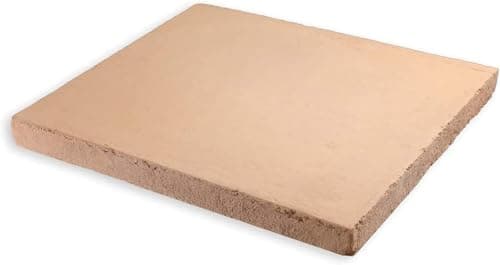
Casapulla Biscuit Refractory Stone, 33.5 x 33.5 x 2 cm
The clay Neapolitan pizzerias bake on, in the only listing we could find that was actually in stock. It is the right stone above 800 F and the wrong stone in a 550 F kitchen oven, and almost nothing about its physics is published.
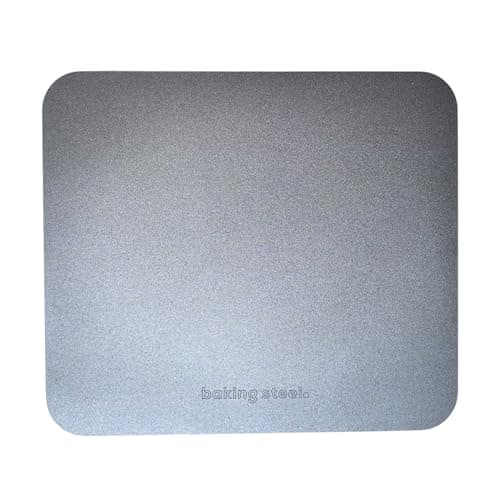
A quarter inch is the thickness where a steel stops being a novelty and stays a thing you can still lift. Its advantage over a stone is not preheat speed - it is what happens one second after the base lands.
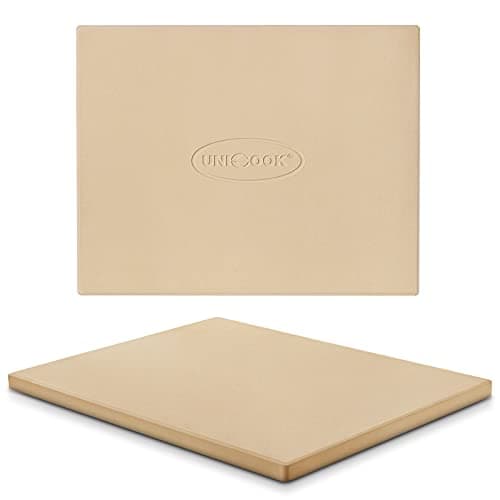
Unicook Heavy Duty Cordierite Pizza Stone, 15 x 12
A rectangle uses an oven rack better than a circle does, and at 6.6 published pounds this is the lightest surface here that still holds a useful amount of heat.
A porous clay slab from the Naples area, usually sold as Saputo, Biscotto di Sorrento or Casapulla biscuit. Its published advantage is absorbing moisture from the dough so the base sets without burning at Neapolitan temperatures, rather than holding or conducting more heat than a ceramic stone.
Is biscotto worth it in a home oven?+
No. The clay exists to stop bases scorching at 806 to 896 F, and a kitchen oven tops out around 500-550 F, where nothing is scorching in the first place. In a home oven a steel or a cordierite stone will bake the same pizza for a fraction of the price.
How hot can a biscotto stone go?+
The official Saputo retailer publishes 500 C, which is 932 F. The Amazon listings we checked publish no maximum temperature at all, and no kiln publishes a density, conductivity or specific heat for the clay.
Can you wash a biscotto stone?+
No. The retailer's instructions say never to use water - wipe it with a barely damp cloth before first use, then remove residue with a metal brush. Porous clay takes water in and staining is permanent and expected.
Are Saputo, Sorrento and Casapulla the same stone?+
Not necessarily, and vendors use the names interchangeably. One Italian kiln explicitly distinguishes Biscotto di Sorrento from the Casapulla biscuit and claims only the Sorrento clay absorbs dough humidity well enough to avoid burning the base. No independent side-by-side is published, so read the listing title carefully before paying.
Sources
Every number on this page came from one of these, or from arithmetic on one of these that we showed in full.