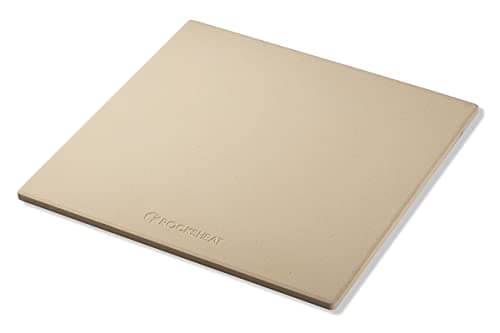
Run the oven at full temperature for 30 minutes, let it cool, brush the ash off dry, and flip the stone so the next fire cleans the other face. No water, no soap, ever.
Heads up: some links on this page are affiliate links. If you buy through one we may earn a commission at no extra cost to you. It never changes a ranking, and we accept no payment for placement. The full version.
The procedure, in four steps
This is the method Ooni publish for their own baking stones, and it is dry from start to finish.
1. Burn it off. Run the oven at top temperature for 30 minutes. Ooni's regional guidance puts a number on it - 450 to 500 C, which is 850 to 900 F - and the residue turns to ash. Light residue, they note, will simply burn off during the preheat before your next cook, so most weeks there is nothing to do at all.
2. Let it cool. Their instruction is explicit: cool the oven before you brush or remove the stone. This is not only a burn risk. A hot stone is a stone under thermal stress, and brushing or lifting one is how you find out how brittle cordierite is.
3. Brush it dry. Sideways, back and forth, with a brush, then wipe with a dry cloth. The ash comes off; the stains do not, and are not meant to.
4. Flip it. If debris is still stuck after cooling, take the stone out, turn it over and put it back. The next fire "self-cleans" that face, in Ooni's own wording, and their product pages suggest flipping before the next use anyway to burn off excess flour. A square floor has two working faces and most owners only ever use one.
The two things that must never touch it
Water. Ooni's wording: "It is important that you do not apply any liquid directly to the stone or submerge the stone in water." Two separate failure modes sit behind that. Water on hot stone is a sudden temperature change, and sudden temperature changes crack stones - their page says exactly that, and the mechanism is in why pizza stones crack. Water in a cold stone is worse in a different way: a porous body holds it, and the next fire turns that trapped water into steam inside the stone.
Soap. "We do not recommend washing your pizza stone with soap or water." Unglazed cordierite absorbs detergent and gives it back, as flavor, for months. Dish soap is for the oven's outside, cleaned only when the oven is completely cool.
850-900 F
The burn-off temperature Ooni publish for clearing residue off a baking stone
30 minutes at the oven's top setting. A domestic oven maxing out near 550 F cannot do this, which is why the home-oven cleaning method is a different page.
Why this is not the same job as cleaning a kitchen stone
The method on how to clean a pizza stone is written for a stone in a domestic oven that tops out around 550 F. That is enough to carbonize cheese over an hour, and it is the right approach for a kitchen.
An outdoor oven runs 300 to 400 degrees hotter and gets there in 15 to 20 minutes, which changes three things:
Kitchen stone, 550 F oven
Outdoor oven floor, 900 F
Burn-off
An hour at maximum, and it smokes the kitchen
30 minutes at top temperature, outdoors, no consequence
Flipping
Rarely practical - the stone sits on a rack and often has a shaped face
Standard practice; the floor is a flat slab with two usable faces
What accumulates
Carbonized oil and sugar, slowly
Scorched flour and semolina from every launch, fast
Who tells you
Nobody - stone makers publish almost nothing
The oven maker publishes a procedure, because the floor is a serviceable part
That third row is the practical one. Launching into a 900 F oven means loose flour and semolina under every base, and it scorches on contact - the trade-off is discussed in perforated vs solid pizza peel, because shedding that excess before launch is most of what a perforated peel is for. Black patches on a floor are mostly that, and they are harmless.
What we did not do
We have not baked on any of these. Every guide in this category says it tested a dozen stones; we would rather say plainly that we did not. What we did instead is on this page in full: published specs with their sources, thermal arithmetic from material constants with the working shown, and the makers' own manuals read rather than paraphrased.
When the floor is finished rather than dirty
Ooni are clear that stains and discoloration are normal and are not a reason to replace anything - a sign of a well-used oven, in their words - as long as the surface is smooth. The only replacement trigger they publish is instability: a hairline crack may not affect performance, but a stone that no longer sits flat should be replaced.
We would add one more from the physics rather than from the maker. A floor that has separated into pieces, or that has a step across a crack, is a floor that will catch a peel and tear a base off it mid-launch. At that point it is a consumable, not a repair.
A hairline crack that still sits flat is cosmetic by the maker's own guidance. A piece that rocks, or a step you can feel with a fingernail, is a replacement.
Replacement floors, and the fitment rule that governs them
This is the point at which cleaning turns into a purchase, so be precise about the one thing that decides it: a replacement floor has to match the cavity in all three dimensions, and no amount of material quality rescues a stone that does not fit. The model-by-model published numbers are in pizza stones for Ooni and portable ovens, including the honest assessment of third-party fitment claims. What follows is only the replacement decision.
Best for replacing a 12-inch oven floor cheaply: the ROCKSHEAT 13.2-inch square. Its listing publishes all three dimensions - 13.2 x 13.2 x 0.4 inches - and names the Ooni Koda 12, Fyra 12 and Uuni ovens, which is more fitment information than most third-party floors give you. Square, so it has two faces to flip between. The honest caveats: no published weight and no published heat rating, on a part that lives at 900 F, so the 5.3 lb figure on its card is ours, derived from the published dimensions - and third-party fitment is the stone maker's claim, not Ooni's.
Best for a Koda 16 owner who wants the maker's own part: the Ooni Koda 16 baking stone (and this is the fitment-certain option). Ooni publish its dimensions against their own cavity, which removes the fitment question entirely. It is the expensive way to solve this and the only way to be certain.
Best for keeping a spare on the shelf for a 13-inch cavity: the Ooni baking board. The standard 10 mm floor these ovens ship with, bought as a spare so a cracked stone does not cost you a weekend. Keeping the old one as the second face is the cheaper version of the same idea.
One thing not to do: move a kitchen stone into an outdoor oven. A 15 mm cordierite slab sized for an oven rack is the wrong dimensions, and a body that has spent a year absorbing oil at 500 F is not a body to introduce to 900 F. The Ooni guide above makes that case with the published numbers.
The picks
What we would buy
ROCKSHEAT
ROCKSHEAT Square Cordierite Baking Stone, 13.2 x 13.2 x 0.4
A replacement floor for a 12-inch portable oven, sized to the cavity rather than to your kitchen oven. The listing publishes its three dimensions and its material and then stops, which is more than most replacement floors manage and less than you would like.
The correct replacement floor for a Koda 16, published to the millimeter. Buy it for the oven it belongs to and for nothing else - the footprint is wrong for a domestic oven rack.
#ad We hold no verified live price for this product, so we show none. How this site is funded.
Ooni
Ooni Pizza Stone, 10 mm
Designed as a replacement floor for a 12-inch portable oven, not as a home-oven stone, and at 10 mm it behaves like one. Buy it for the oven it belongs to.
#ad We hold no verified live price for this product, so we show none. How this site is funded.
Questions
Frequently asked
How do you clean an Ooni pizza stone?+
Dry, and with heat rather than with anything you would use on a dish. Run the oven at its top temperature for 30 minutes, let it cool, brush the ash off with a sideways motion and wipe with a dry cloth. If anything is still stuck, flip the stone over and let the next fire clean that face.
Can you use water on a pizza oven stone?+
No. Ooni's published instruction is not to apply any liquid directly to the stone or submerge it, because sudden temperature changes crack stones and a porous body holds onto water that then turns to steam inside it on the next fire. Soap is also out - the stone absorbs it and releases it back into your food as flavor.
Should you flip the stone in a pizza oven?+
Yes, and the maker recommends it twice: once as the fix for stubborn debris, and once as routine practice before the next cook to burn off excess flour. A flat floor has two working faces, so flipping roughly doubles the time before it looks tired.
How do you get burned flour off a pizza oven floor?+
Heat, then a brush, then a flip - in that order, and never water. Scorched flour and semolina from launching is the main thing that accumulates on an outdoor oven floor. If it is a recurring annoyance, the cause is excess flour going in with the pizza, which is what shaking the peel before launch and using a perforated peel are for.
When should you replace a pizza oven stone?+
When it stops sitting flat. Ooni say a small hairline crack may not affect performance and that stains and discoloration are entirely normal, but that an unstable stone should be replaced. A floor with a step across a crack will also catch a peel mid-launch, which is its own reason.
Does a stained pizza oven stone need replacing?+
No. Unglazed cordierite goes brown and then patchy black on the first few bakes and stays that way; Ooni describe the color change as the sign of a well-used oven. It has no effect on how the floor bakes. The only staining worth acting on is a genuinely greasy patch, which a 30-minute burn-off deals with.
Sources
Every number on this page came from one of these, or from arithmetic on one of these that we showed in full.