Get a thin, cheap cordierite stone - the Unicook 15 x 12 - and skip everything thicker. A 22-minute bake at 400 F does not drain a heat reservoir, so the thickness you would be paying for does nothing here.
Heads up: some links on this page are affiliate links. If you buy through one we may earn a commission at no extra cost to you. It never changes a ranking, and we accept no payment for placement. The full version.
The answer first
Buy the cheapest competent cordierite stone that fits your oven - for most people the Unicook 15 x 12, at a published 6.6 lb - and do not spend anything on thickness. A stone genuinely improves a frozen pizza, and the published bake instructions on the box are the reason the expensive stone is wasted money for this job.
That is a different recommendation from the main stone roundup, which is written for someone making dough from scratch at 550 F. If frozen pizza is most of what comes out of your oven, keep reading, because the physics of your bake is not the physics that roundup is ranking for.
Start with what the box actually says
DiGiorno publish their instructions per product, and the numbers are consistent across the range: preheat and bake at 400 F, place the pizza on the center oven rack, 6 to 8 inches from the bottom of the oven, bake 21 to 24 minutes for a Rising Crust Three Meat (22 to 25 for the Supreme, 20 for the Four Cheese), keep it frozen while the oven preheats, do not let it thaw, and let it stand about five minutes before eating. Their FAQ gives the range across their whole line as 375 F to 425 F depending on crust style.
400 F for 22 min
The published bake for a rising-crust frozen pizza, against 550 F for six minutes for a fresh Neapolitan
DiGiorno's own per-product instructions. Every argument for a heavy stone is built on the second number, not the first.
Hold those two bakes side by side, because almost every stone recommendation you will read was written for the second one.
Why thickness stops mattering at 22 minutes
A thick stone sells one thing: a large reservoir of stored heat that dumps into a wet base faster than the base can cool it. In a six-minute Neapolitan bake that reservoir is genuinely being drained, and running out of it is what gives you a pale, soft base.
A 22-minute bake at 400 F does not drain anything. The oven element keeps feeding the cabinet the whole time, and on this site's own preheat model a stone closes 95 percent of the gap to oven temperature in the following times from cold:
Stone
Published or derived mass
Mass per unit area
To 95% of oven temperature
Stored at 500 F
Unicook 10.25" round, 0.4"
2.5 lb (derived)
21.3 kg/m2
About 20 min
0.062 kWh
Unicook 15 x 12, 0.6"
6.6 lb (published)
25.8 kg/m2
About 24 min
0.165 kWh
Old Stone 16" round, 0.5"
10 lb (published)
35.0 kg/m2
About 34 min
0.249 kWh
Every one of those stones reaches oven temperature during a preheat you were doing anyway, and then sits there at 400 F for the entire 22 minutes with the element topping it up. The pizza takes a small bite out of the surface temperature in the first minute and the oven replaces it. The reservoir never becomes the limiting factor, so the extra 3.4 lb and the extra ten minutes of preheat you pay for in the Old Stone buy you nothing a frozen pizza can use.
We have not baked on any of these. Every guide in this category says it tested a dozen stones; we would rather say plainly that we did not. What we did instead is on this page in full: published specs with their sources, thermal arithmetic from material constants with the working shown, and the makers' own manuals read rather than paraphrased.
What a stone does still buy you here
This is not an argument for baking on the rack. Two of the three things a stone does survive the switch to a 400 F bake intact.
A flat, continuous surface instead of five wire bars. On a bare rack the base browns in stripes where the metal touches and stays pale between. A stone browns the whole underside. This is the biggest visible difference and it has nothing to do with thickness.
Moisture out of the base. Unglazed cordierite is porous, and over 22 minutes it wicks water out of the underside rather than letting it sit there as steam. That is the mechanism behind the single complaint everyone has about frozen pizza - a floppy center - and it is covered properly in why is my pizza crust soggy.
What does not survive: the instant-sear argument. A frozen base is not a wet raw dough that needs setting in ninety seconds. It arrives par-baked. The dramatic contact-temperature physics that makes a steel worth owning - the subject of pizza stone vs steel - is solving a problem you do not have.
The box says the center rack, 6 to 8 inches up. A stone on that rack changes the base from striped to evenly browned, which is most of what anyone actually wanted.
The one real risk, and it is not the one you think
A frozen slab landing on a preheated stone is a thermal shock event, and it is the single way people destroy a stone doing this. The mechanism - a steep temperature gradient across a brittle ceramic body that is weak in tension - is the subject of why pizza stones crack.
The mitigation is ten minutes on the counter before the pizza goes in. That is in slight tension with DiGiorno's "do not thaw", so be precise about what each instruction is for: their warning exists so a pizza is not left out long enough to go soft and lose food-safety margin over hours. Ten minutes off the freezer edge is not thawing, and it is the difference between a stone that lasts ten years and one that cracks in its first winter.
And take the cardboard disc off. It is there for freight, it insulates the base from the stone, and leaving it on means you preheated a stone for nothing.
So what to buy
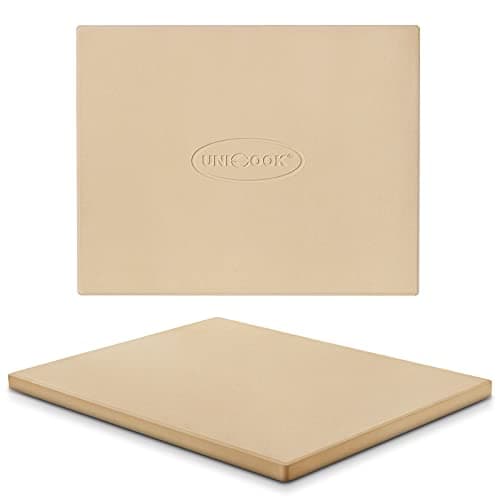
Best for frozen pizza: the Unicook 15 x 12. A published 6.6 lb, 0.6 inches, 180 square inches of rectangle - which suits the rectangular rack of a domestic oven better than a round stone does - and about 24 minutes to temperature. It is the cheapest of the three and the one we would buy for this. Our full look at it is in the Unicook review.
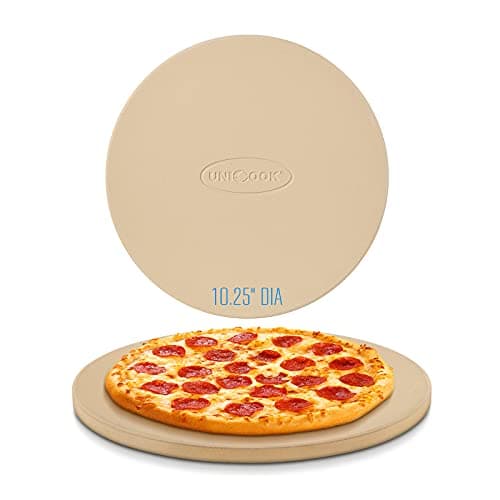
Best for a small oven or a single-serve frozen pizza: the Unicook 10.25-inch round. 83 square inches, the fastest to temperature at about 20 minutes, and the one to get if your cavity is genuinely tight - sizing is in what size pizza stone do I need.
Best if you also make pizza from scratch: the Old Stone 16-inch round. Ten published pounds and 0.25 kWh at 500 F. For frozen pizza alone that mass is dead weight and ten extra minutes of preheat. For a Friday dough it is the reason to own it. Buy this one for the pizza you make, not the pizza you unwrap.
What we would skip entirely for this job: steels, half-inch plates, cast iron, and anything described as a baking stone for professional ovens. The case for each of those is a short, hot bake, and your bake is neither.
The picks
What we would buy
Unicook
Unicook Heavy Duty Cordierite Pizza Stone, 15 x 12
A rectangle uses an oven rack better than a circle does, and at 6.6 published pounds this is the lightest surface here that still holds a useful amount of heat.
The best-documented small stone here: the maker publishes the thickness, the kiln temperature and a 1450 F limit, and throws in the scraper. A third thicker than the toaster-oven stones, which is the compromise worth making if your cavity allows it.
The most useful stone shape for a home oven, at a weight one hand can manage, and one of the very few whose retailer publishes both a thickness and a weight.
Yes, if you have one - it browns the whole underside instead of striping it on the rack bars, and it wicks moisture out of the base over a 20-minute bake. Preheat the stone with the oven, take the cardboard disc off, and give the pizza ten minutes out of the freezer first so you are not dropping a frozen slab onto hot ceramic.
What temperature for frozen pizza on a pizza stone?+
Use the temperature on the box, not a pizza-stone temperature. DiGiorno publish 400 F for their rising crust line and give 375 F to 425 F as the range across their products. Raising it to 500 F because the stone can take it will burn the base long before the middle is hot - this is a par-baked base, not raw dough.
Do I need a thick pizza stone for frozen pizza?+
No, and this is the only recommendation on this page that will cost you money if you get it wrong. Thickness buys stored heat, and stored heat matters when a six-minute bake drains it. Across a 22-minute bake at 400 F the oven keeps the stone topped up the whole time, so a 6.6 lb stone and a 10 lb stone behave the same and only one of them took 34 minutes to preheat.
Will a pizza stone crack if I put frozen pizza on it?+
It can. A frozen slab creates a very cold patch on a very hot brittle surface, which is exactly the thermal shock that cracks stones. Ten minutes on the counter first removes almost all of it. A stone that has already cracked is finished, which is why this is the one rule on this page worth being fussy about.
Is a pizza stone or a perforated pan better for frozen pizza?+
A stone, for browning; a perforated pan is easier to live with. The pan gets airflow to the base without needing a preheat and without any thermal-shock risk, but it touches the base in a hole-punched pattern rather than continuously. We have compared the two properly in pizza screen vs stone vs perforated pan.
How long do you preheat a stone for frozen pizza?+
Longer than the oven takes. On our model a 6.6 lb stone needs about 24 minutes to reach 95 percent of oven temperature and a 10 lb one about 34, while the oven beeps at around 15. Put the stone in cold, set 400 F, and start the clock when you turn the oven on rather than when it beeps. The arithmetic is in how long to preheat a pizza stone.
Sources
Every number on this page came from one of these, or from arithmetic on one of these that we showed in full.