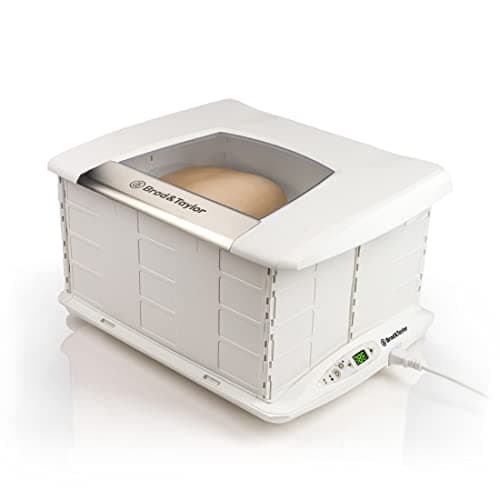
An excellent appliance with an unusually honest manual. Whether it belongs in a pizza kitchen comes down to three interior dimensions, and we measured your containers against them.
Heads up: some links on this page are affiliate links. If you buy through one we may earn a commission at no extra cost to you. It never changes a ranking, and we accept no payment for placement. The full version.
What this review is
We have not proofed dough in this appliance. What follows is what Brod & Taylor publishes on its product page, its Amazon listing and its instruction manual, and what those figures mean for someone who makes pizza rather than sandwich loaves. The standing method is on the methodology page.
What we did not do
We have not baked on any of these. Every guide in this category says it tested a dozen stones; we would rather say plainly that we did not. What we did instead is on this page in full: published specs with their sources, thermal arithmetic from material constants with the working shown, and the makers' own manuals read rather than paraphrased.
The published specification
Specification
Published figure
Proofing range
70-120 F, with optional humidity from the included water tray
Slow Cook range
85-195 F (30-90 C), set in 5-degree increments
Interior
14.75" W x 12.5" D x 8" H
Exterior, open
18" x 14.5" x 10" H
Folded height
2.75"
Weight
9.5 lb (4.3 kg)
Power
200 W at 120 V (model FP-105)
Warranty
3-year limited, with product registration
That is a complete spec sheet, and it is worth noticing because the cheaper devices in this category mostly do not publish a wattage, a control increment or an interior dimension at all - the comparison is in the dough proofer roundup.
The sentence in the manual that matters most
Buried on page 14 of the instruction manual is a line that tells you more about this appliance than the marketing does: the Proofer "is calibrated to keep its contents near the temperature setting, not the air inside."
Contents, not air
What the Folding Proofer's thermostat is calibrated to control, per its own manual
That is the correct engineering choice. Dough does not care about air temperature; it cares about its own temperature, and the gap between the two is exactly what makes a proofed dough unpredictable.
It also means the number you set is closer to the number your dough experiences than on a device that regulates air. The manual adds a caution in the same spirit: humidity from the water tray raises the temperature of what is inside. If you use the tray, set a little lower than you would dry.
Will your pizza containers actually fit?
This is the question no listing answers, and for a pizza maker it decides the purchase. The interior is 14.75 by 12.5 inches of floor with 8 inches of height. Here is what that does with the containers ranked in the container roundup, using each maker's published dimensions.
Container
Published size
Fits?
Cambro 2-quart round (RFSCW2)
8 3/16" top diameter x 4 3/16" high
One per level. Two side by side need 16.4" against 14.75"
Cambro 6-quart round (RFSCW6)
8 13/16" top diameter x 10 7/8" high
No - nearly 3" taller than the 8" interior
Ooni dough box
16.7" x 12.7" x 3.7"
No - too wide by nearly 2" and too deep by 0.2"
That result is the review in miniature. This is a bowl-sized appliance. It takes a mixing bowl of bulk dough, or one 2-quart tub, or a quarter-sheet tray of rolls. It does not take a batch of pizza dough balls laid out the way pizza makers usually store them, and the dough box most outdoor-oven owners already have does not go in at all.
Measure before you buy. The most common pizza dough container on this site fits once per level; the dough box most portable-oven owners already own does not fit at all.
Where it genuinely earns its price
Bulk fermentation in a cold kitchen. This is the job the dimensions suit. One large bowl of dough, held at a set temperature for hours, in a kitchen that would otherwise sit at 62 F overnight. The difference between a bulk ferment that finishes in four hours and one that finishes in nine is almost entirely temperature, and this holds it. The full temperature picture is in the proofing temperature guide.
A sourdough starter, year round. A starter jar fits comfortably, and a starter is the thing in a pizza kitchen that benefits most from being held at one temperature every day. Brod & Taylor also makes a jar-sized box that cools as well as heats, which is the better tool if the starter is all you want to control - see sourdough pizza basics for why the starter matters.
Being more than a proofer. The listing states it slow-cooks, ferments yogurt and kombucha, and melts chocolate, and the manual gives the Slow Cook mode its own 85 to 195 F range in 5-degree steps. If those uses matter to you, they change the value arithmetic considerably.
Storage. Folded, it is 2.75 inches high. A seasonal appliance that goes flat into a cupboard is one that stays in the kitchen.
Where it does not
Cold-fermented pizza dough. Most good pizza dough spends 24 to 72 hours in a refrigerator, and warmth shortens that window rather than improving it. For that dough, the right appliance is the fridge you already own and the right purchase is containers - how to store pizza dough covers the routine.
Batches of dough balls. As the table shows, one 2-quart tub per level. The optional accessory shelf adds a second level, which helps, but it is still a small number of balls for a considerable outlay.
A kitchen that already sits at 70 to 76 F. If your kitchen holds a sensible temperature, the proofer is solving a problem you do not have. Put a thermometer where your dough sits and read it morning and evening before you buy anything.
What it costs to run
The published draw is 200 W. At the US average residential electricity rate of 18.34 cents per kWh, published by the EIA for June 2026, a four-hour proof costs at most about 15 cents - and less in practice, because a thermostat spends most of its time off once the contents are at temperature. Running cost is not a reason to hesitate.
Against the alternatives
The Raisenne Dough Riser is a heated mat that holds about 85 F under a bowl, stores in a drawer and costs a fraction as much. It has no control and no published wattage, but for one bowl in a cold kitchen it does most of what the proofer does.
A 2-quart Cambro and your refrigerator is the right answer for most pizza-only households, at a small fraction of the money. The Cambro is also the one container on this site that fits inside the proofer, which is a useful thing to know if you buy both.
Your oven with the light on works only if the bulb is incandescent. An LED oven lamp produces very little heat.
The verdict
The Folding Proofer is the best-specified device in its category, with a manual honest enough to tell you its thermostat targets the contents rather than the air and that the water tray will push temperatures up. As an appliance it deserves its reputation. As a pizza purchase it is narrower than it looks: excellent for bulk dough and starters in a cold kitchen, redundant for cold-fermented dough, and physically too small for the dough boxes and larger tubs pizza makers already own. Measure your containers first.
The picks
What we would buy
Brod & Taylor
Brod & Taylor Folding Proofer & Slow Cooker, FP-105
The only proofer here that publishes every number you would want before buying, and the only one that folds to under three inches when you are done with it.
#ad We hold no verified live price for this product, so we show none. How this site is funded.
Raisenne
Raisenne Dough Riser
A flat heated mat that holds about 85 F under a bowl. Not a box, not a controller, and priced far below either - the cheapest honest way to warm a cold kitchen's dough.
#ad We hold no verified live price for this product, so we show none. How this site is funded.
Questions
Frequently asked
Is the Brod & Taylor Folding Proofer worth it for pizza dough?+
For bulk fermentation in a cold kitchen or keeping a sourdough starter, yes. For cold-fermented pizza dough, no - that dough wants the refrigerator, and warmth shortens the window rather than improving it.
How many dough containers fit inside?+
The interior is 14.75 by 12.5 by 8 inches. One Cambro 2-quart round fits per level, since two side by side need about 16.4 inches. A Cambro 6-quart is too tall and an Ooni dough box is too wide, so neither fits.
What temperature range does it cover?+
70 to 120 F for proofing, with optional humidity from the water tray, and a separate Slow Cook mode from 85 to 195 F in 5-degree increments, per the listing and the manual.
Does the water tray change the temperature?+
Yes. The manual states that humidity from the water tray raises the temperature of the items inside, so set slightly lower when you use it.
How much does it cost to run?+
At its published 200 W and the June 2026 US average of 18.34 cents per kWh, a four-hour proof costs at most about 15 cents, and less in practice because the heater cycles off.
Sources
Every number on this page came from one of these, or from arithmetic on one of these that we showed in full.