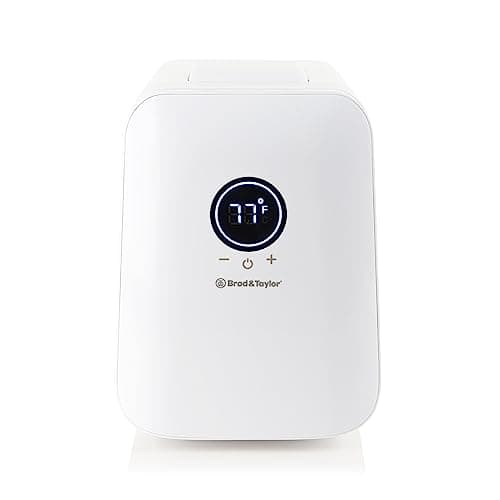
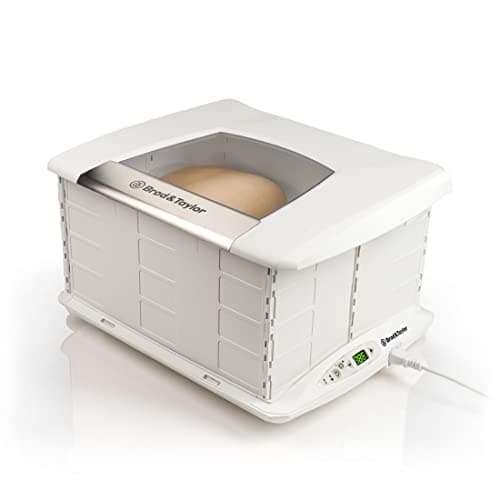
Buy it to control a starter, not to proof pizza dough. Brod & Taylor's own FAQ points dough proofers at the Folding Proofer instead, and the published interior - 7.5 by 5.1 by 5.5 inches - is why.
Heads up: some links on this page are affiliate links. If you buy through one we may earn a commission at no extra cost to you. It never changes a ranking, and we accept no payment for placement. The full version.
The verdict, and it comes from the maker
If you keep a sourdough starter and you want to decide when it peaks rather than negotiate with your kitchen, this is the right appliance and there is nothing else quite like it. If you came here to proof pizza dough in it, buy the Folding Proofer instead - and that is not our opinion, it is Brod & Taylor's. Their own FAQ states that the Folding Proofer is "larger and better suited for proofing dough or bulk fermentation".
A manufacturer steering you from a $149 product to a $249 one is unusual enough to take at face value, and the published interior dimensions back it up. This review is mostly about why that is the right call, and what the thing is genuinely excellent at.
What this review is
We have not run a starter in one for a year. What follows is the published specification from Brod & Taylor's own product page, and the arithmetic that specification implies for a pizza household specifically. That arithmetic is the entire reason to buy this or to buy something else. The method is on the methodology page.
What we did not do
We have not baked on any of these. Every guide in this category says it tested a dozen stones; we would rather say plainly that we did not. What we did instead is on this page in full: published specs with their sources, thermal arithmetic from material constants with the working shown, and the makers' own manuals read rather than paraphrased.
The published specification
Specification
Published figure
Temperature range
41 to 122 F (5 to 50 C)
Hold accuracy
Within 1 to 3 F of the set point
Heats and cools
Both - "heats when it's too cool", "cools when it's too hot"
Interior dimensions
7.5 in H x 5.1 in W x 5.5 in D (19 x 13 x 14 cm)
Exterior dimensions
11 in H x 8 in W x 10 in D (28 x 23 x 25 cm)
Weight
4.1 lb (1.86 kg)
Power draw
38 W maximum cooling, 20 W maximum heating
Voltage
100 to 240 V
Jar capacity
Jars up to 1 liter / 1 quart; works with most standard glass jars including Weck and Ball
Warranty
3-year limited, with registration
Starter jar included
No - sold separately or as a bundle
The number that decides it: 5.1 inches of width
The specification that rules this product in or out of a pizza kitchen is not the temperature range. It is the interior: 7.5 inches tall, 5.1 wide, 5.5 deep.
Put a pizza dough ball against that. A 280 g ball - the middle of the range in our dough ball weight chart - sits in a container of around 5 inches across once it has relaxed, and a Friday night for four people is four of those. The round Cambro containers we rank for exactly this job are 8 and 3/16 inches across. One of them does not go through a 5.1-inch opening, let alone four.
5.1 in
Interior width of the Sourdough Home, against the 8.2-inch diameter of the proofing container we rank first
This is the whole reason the maker points dough proofers at the Folding Proofer. It is a jar cabinet, and jars are what fit in it.
What does fit is jars: up to a liter, and up to four of the maker's small 1.5-cup starter jars at once. That is what it is for. Read the interior dimension as a statement of purpose rather than a limitation and the product makes complete sense.
What 41 to 122 F with cooling actually buys a pizza baker
Here is where it earns its place in a pizza kitchen, even though no dough will ever go inside it.
Almost every cheap proofing device only heats. That is fine in a cold kitchen and useless in a warm one - and a warm kitchen is the harder problem, because an over-warm starter runs fast, peaks while you are at work, and collapses before you can use it. The published 41 F bottom end is the thing nothing else in the category offers: a starter held at fridge temperature, or at a deliberate 50 F to stretch a feed out across a weekend, in a warm room, without a fridge shelf.
The 1 to 3 F hold band matters more than it looks. Fermentation rate roughly doubles for every 17 F of temperature, so a kitchen that swings 10 degrees between afternoon and 3 a.m. is changing the speed of the culture by about half - which is why the same feeding schedule gives a different starter in February and August. Holding to within 3 F takes that variable out, and a starter you can predict is a dough you can schedule. The temperature side of that is the subject of the proofing temperature guide.
The running cost is trivial: 20 W heating and 38 W cooling at maximum, which is less than a light bulb for the heating case. That is the honest comparison point against the oven-with-the-light-on method, which does not cool at all and cannot be set.
A starter is a culture with a temperature-dependent clock. This appliance is a way of setting that clock, and that is the entire product.
What the maker does not publish, and it is not nothing
No stated cooling mechanism. The page says it cools but does not say how. A 38 W draw and a 41 F floor in a 4.1 lb box are consistent with a thermoelectric module rather than a compressor, which would also explain the limited pull-down below ambient. We are not going to assert it, because they do not.
No stated temperature differential. "41 to 122 F" is the set range, not a promise about how far below room temperature it can reach. In a 90 F kitchen, 41 F is a long way down for a thermoelectric cooler. If you intend to use the bottom of the range in a hot climate, that is the question to ask before buying, and the answer is not on the page.
Box contents are unclear. The starter jar is sold separately unless you buy the bundle, and the page does not plainly list what ships in the base carton.
Placement caveat. They do advise against putting it next to ovens or in direct sunlight - which, for a device whose selling point is holding a temperature in a warm room, is worth reading twice.
How it sits against the Folding Proofer
Sourdough Home
Folding Proofer & Slow Cooker
What the maker says it is for
Starter maintenance
"larger and better suited for proofing dough or bulk fermentation"
Cools below room temperature
Yes, to a set 41 F
No
Fits pizza dough balls
No - 5.1 inches of interior width
Yes
Folds flat for storage
No
Yes
Weight
4.1 lb published
Published on its own page
The row that matters for this site is the third one. Our full assessment of the other machine is in the Folding Proofer review, and the two are ranked against the rest of the category in the proofer roundup.
Buy it, or buy one of these instead
Best for controlling a starter in a warm or swinging kitchen: the Sourdough Home itself. Buy it if you keep a starter year-round and you are tired of a culture that peaks on its own schedule. The cooling is the feature and almost nothing else offers it.
Best for proofing pizza dough: the Folding Proofer. Buy this instead if the thing you want warmed is dough. It is the maker's own recommendation for that job, it folds flat, and it covers the temperatures a pizza dough actually needs.
Best for a starter if you already own a fridge: a 2-quart Cambro. Buy this instead if what you really need is somewhere controlled and you are willing to use a fridge shelf. A sealed container holds a starter at about 38 to 40 F for nothing, and it is the honest free version of the bottom half of this appliance's range. What it cannot do is hold 50 or 60 F, which is the interesting part of what you are paying for.
Do not buy it as a pizza-dough proofer, as a way to proof four dough balls, or expecting a published cooling differential. Two of those are design decisions and the third is a gap in the documentation.
The picks
What we would buy
Brod & Taylor
Brod & Taylor Sourdough Home
A small box that both heats and cools, which is the rarer and more useful half of the problem in a kitchen that swings from 62 F in winter to 82 F in August.
Brod & Taylor Folding Proofer & Slow Cooker, FP-105
The only proofer here that publishes every number you would want before buying, and the only one that folds to under three inches when you are done with it.
#ad We hold no verified live price for this product, so we show none. How this site is funded.
Questions
Frequently asked
Is the Brod & Taylor Sourdough Home worth it?+
For a starter, yes - it is the only mainstream device that both heats and cools to a set point, with a published 41 to 122 F range and a 1 to 3 F hold band, on 20 to 38 W. For pizza dough, no: the published interior is 5.1 inches wide and the maker points dough proofers at the Folding Proofer instead.
Can you proof pizza dough in a Sourdough Home?+
Not usefully. The interior is 7.5 by 5.1 by 5.5 inches, which will not take the round proofing containers we rank - those are 8 and 3/16 inches across - and certainly not four of them. Brod & Taylor's own FAQ says the Folding Proofer is larger and better suited to proofing dough or bulk fermentation.
What temperature should I set for a sourdough starter?+
The device's usefulness is that this becomes a decision rather than a guess. Warmer inside the published range runs the culture faster and needs more frequent feeding; cooler slows it down, and the 41 F floor is effectively a fridge you can set. We will not invent a single number here - fermentation rate roughly doubles per 17 F, so the right setting depends on your flour, your culture and when you want it to peak. The mechanics are in the proofing temperature guide.
Does the Sourdough Home actually cool, or just heat?+
It cools as well as heats - the published range runs down to 41 F and the maximum cooling draw is 38 W against 20 W for heating. What Brod & Taylor do not publish is the mechanism or the differential it can achieve below room temperature, so if you plan to use the bottom of the range in a hot kitchen, ask them before buying.
What size jars fit in it?+
Jars up to 1 liter or 1 quart, and the maker states it works with most standard glass jars including Weck and Ball. Up to four of their 1.5-cup small starter jars fit at once. No jar is included in the base product - it is sold separately or as a bundle.
How much electricity does it use?+
A published maximum of 38 W cooling and 20 W heating, and less than that in practice since it cycles rather than running flat out. For context, our figures for running a domestic oven are in what preheating costs - a single pizza preheat uses more energy than days of holding a starter.
Sources
Every number on this page came from one of these, or from arithmetic on one of these that we showed in full.